
4 January 2007 04:12 Home > News > Environment
from The Independent & The Independent on Sunday
Starving Polar Bears Shame Bush to Act
By Geoffrey Lean, Environment Editor
Published: 12 February 2006
Starving polar bears are presenting an unprecedented challenge to George Bush's refusal to take action over global warming - and may succeed where environmentalists and other governments have failed in getting him to curb pollution.
Despite the President's obdurate stance on climate change, the US administration last week took the first steps towards officially listing the bear as an endangered species. The Arctic ice on which the iconic animal lives is melting away as the world heats up and, if the listing is finalised, the Bush administration will be obliged to modify its pollution policies to try to save the bear.
The move comes as the President faces attack for the first time over global warming from some of his strongest allies. Evangelical Christian leaders last week took out TV ads urging action, while, in Britain, Tony Blair has warned that the world has less than seven years to get to grips with climate change.
The Prime Minister made his statement on Tuesday, the same day the US Fish and Wildlife Service started the process of listing the polar bear in response to a lawsuit by environmental groups to get government protection for the species. It said the groups had presented "substantial scientific and commercial information indicating that listing the polar bear may be warranted".
The bears are vulnerable to climate change because they depend entirely on the polar ice to catch seals, their main prey. The seals swim too fast in open water, and so bears have to lie in wait for them to surface for air through holes and cracks in the ice. The seals congregate in the shallow waters of the continental shelves, and the bears can reach them only when the sea is frozen. But the ice now recedes far out to sea every summer.
A new report by the United Nations Environment Programme concludes that the extent of summer ice in the Arctic has shrunk by more than a quarter in the past half-century. The US government's official National Snow and Ice Data Center adds that a "stunning" reduction in sea ice has taken place in the past four years. Last summer an area twice the size of Texas disappeared.
The centre believes that the rate of retreat is accelerating. Worse still for the bears, the melting is starting earlier, depriving them of seals in the spring, when they have always stocked up on food to see them through the summer.
In desperation, more and more polar bears are swimming to land, and marauding through towns and villages. Made fearless by hunger, the half-ton animals have even broken into houses in search of food. One killed a 15-year-old girl in the far western Russian Arctic, while children in the northern Canadian town of Churchill are being taken to school under guard. There is even evidence from north-east Russia that polar bears have taken to eating their own species.
The Fish and Wildlife Service will gather evidence on the state of the bears over the next two months before coming to a decision at the end of the year. But Rosa Meehan, the head of its marine mammal programme in Anchorage, Alaska, has already said: "It's pretty easy to make a connection between what's happening to sea ice and what might happen to polar bears."
If the bear is listed under the US Endangered Species Act, regulatory agencies would be bound by law to take into account how their decisions would affect it. This could lead to tougher measures to control the spread of pollution that causes global warming, and stricter fuel-economy standards for vehicles.
polar bear =

"Honey do I have time to make a breakfast sandwich? And hey, whatta you think about taking out these trees and making the deck bigger? We could put in an hottt-tub, I KNOW you like hot tubs
Also in this section.....
4 January 2007 04:19 Home > News > Environment
The Big Question: How quickly are animals and plants disappearing, and does it matter?
By Steve Connor, Science Editor
Published: 02 January 2007


 = & ? =
Why are we asking this question now?
As 2006 drew to a close, the polar bear was about to be classified as a threatened species by the United States Government. Melting Arctic sea ice could significantly reduce numbers of the world's largest terrestrial carnivore over the next 50 years. And, just before Christmas, a 38-day search for the Yangtze River dolphin ended without finding a single member of the species. It is feared that the aquatic mammal may be the latest in a long line of extinct animals.
Extinction is as old as life on Earth - about 3.5 billion years - but scientists calculate that we are losing species at a rate of somewhere between 1,000 and 10,000 times higher than the natural "background" rate of extinction. This means that technically we are going through a period of "mass extinction", the sixth that we know about over the hundreds of millions of years of the fossil record. But unlike the previous five mass extinctions, this one is largely caused by the actions of a single species - Homo sapiens.
How many species have gone extinct in the past 100 years?
This is a notoriously difficult question to answer, due in part to the difficulty in recording the declining populations of a particular animal or plant, and in part to the technical definition of an extinction. Experts estimate there are 15,589 species threatened with extinction. But a species is only accepted to have become extinct if exhaustive surveys in its known habitat range have failed to find any record of the individual.
So even if scientists strongly suspect that an animal has gone extinct it cannot be defined as extinct until some time has elapsed since an individual was last observed - which can mean 30 or 50 years for some species.
The decline and eventual extinction of an animal or plant may take many decades or even centuries and the final stages are seldom observed. This make it difficult to decide when something has completely died out.
Conservationists calculate that since 1500 there have been more than 800 recorded extinctions. However, the true number of extinctions is likely to be much larger because of what is known about the rate at which habitats are being lost or broken up.
What groups of animals or plants are at the highest risk?
In general, the more we know about a particular group of species, the more we realise that they are at risk. One in four mammals and one in every eight birds is threatened. Half of all tortoises and freshwater turtles are similarly endangered.
Amphibians - frogs, toads, newts and salamanders - are perhaps the largest group of animals at serious risk.
About one in three species of amphibians are seriously endangered in some way or other and more than 120 species are thought to have died out over the past 25 years.
Amphibian specialists believe that a combination of factors may be involved, such as habitat loss and the spread of a deadly fungus, aided by the human trade in an African toad, a known carrier of the disease.
Up to 2,000 species of amphibians - the first vertebrates to conquer the land - are classified as endangered. The group is thought to be particularly vulnerable because their life cycles generally depend on two habitats, terrestrial and aquatic, for survival.
How many species are still alive?
Again, this is another notoriously difficult question. About 1.5 million animals and plants have been identified and formally or informally named. However, the true number of species alive today is likely to fall within the range of between five million and 15 million, although some scientists suggest even higher numbers - perhaps 30 million species in total.
According to studies of the fossil record, which gives a good indication of the diversity of life on Earth over the past 600 million years, only between about 2 and 4 per cent of the species that have ever lived are believed to survive today - the disappearances of the earlier species occurred long before the arrival of the first humans some two million years ago.
Do species have a natural 'lifetime'?
Some species are better than others at surviving for long periods of time. Some adapt to changing environmental conditions and evolve into new species.
Most species eventually become extinct. Animals without backbones, the invertebrates, have an average evolutionary "lifetime" of five to 10 million years. Mammals, on the other hand, are thought to have a lifetime of one or two million years.
However, scientists say that the current lifetimes of some birds and mammals are much shorter than natural lifetimes based on the fossil record. One scientist calculated that the lifetime of a typical bird or mammal species is now about 10,000 years - significantly shorter than the natural average lifetime.
What caused the previous mass extinctions?
We know about the previous five mass extinctions from the fossil record. Studies of the number of marine families over the past 600 million years show five points in time when large numbers of species disappeared abruptly.
The last was 65 million years ago, in which the dinosaurs became extinct, and is thought to have resulted from an asteroid hitting the Earth and causing a dramatic change in the climate. In fact all previous mass extinctions are thought to have been caused by some large-scale geo-physical process, such as supervolcanic eruptions or the sudden release of vast quantities of greenhouse gases from the seabed.
The biggest mass extinction of all occurred some 251 million year ago, when about 90 per cent of marine life and 70 per cent of land species vanished. One theory is that something happened to the Earth's atmosphere at the end of the Permian period, robbing it of vital oxygen.
It has happened before, so why worry?
There are several reasons we should be concerned. The first is that in the past it has taken life on Earth between 10 million and 100 million years to recover from a mass extinction. The second is that for all our technology, we still rely on the delicate ecological balance of the natural world for our survival. The Earth's biodiversity provides us with clean air, drinking water, food and even new drugs - upsetting it too much could cause the collapse of this vital life-support system.
The third reason is philosophical. If we conserve works of art, why should we not also conserve nature? The extinction of a humble beetle is no less important than the wilful destruction of a Rembrandt or a Picasso?
Should we be concerned about the rapid extinction of the Earth's species?
 Yes...
* Life is a delicate web of inter-related species: destroy too many and the entire fabric can come apart
* The natural world is the planet's only life-support system, and if we lose that we lose our own lives as well
* Protecting biodiversity is the moral equivalent to preserving human culture for future generations - it is not ours to destroy
 No...
No... 
* There are millions of species on Earth and the loss of a few won't matter too much
* Life has bounced back in the past when there have been similar mass extinctions
* We can live in a world of fewer species, provided we keep the ones that matter to us
Normally I'd roll with "the weather obviously ain't right, but isn't this a delightful breeze?" punches all the way; home to where the young shoots are coming up in the garden, where the tempurature is going up to a high of 13 I hear, 'nice, more or less'.
Nothing new. Nothing old. Change always? Always change.
I'm Indifferent, but I care about caring about things outside myself (narcicistic-hypocrite). Sometimes the vanity mirror cracks just as you pull your head out of your ass and you see something that steals your focus, unexpected, like when ya'll "what I was looking for!?!!" And maybe you call an epiphany, realization, moment of clarity, your girl, your man, your sponser, whatever.
For me; this time its is large majestic bears who I admire and respect and who I realize wihtout any difficulty love me because I look like a viable food source. Awww.

Polar Bears Aren't All Bad At All
Even though I'm trying real hard to teach them to be. They don't take trips down South for breaks to feed on copious amounts of overweight and morbidly obesed weight classed lethargic bored humans, (which I keep trying to explain are cheap, and easy to plan if you plan early) but they say, "we only want to eat you's because dats wha we's do. RoooOWWWWR"
That's For Bearing Along With It.

Babies are so cute eh?
<shudder>
(in pictures and theories)

"Polar bears eat a lot of seals"

"Cubs eat scouts!"
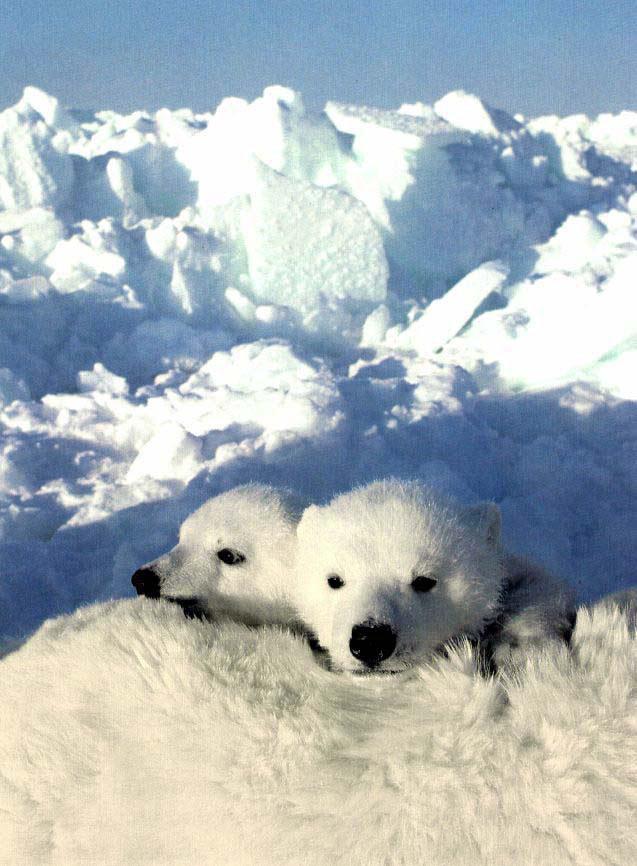
View from the top
.jpg)
"Mommy, where is all the ice going?"

"Don't worry little ones, we're excellent swimmers"

"Hmm, I can probably make it at least to an oil rig.... coupla guys and me, supplies. Yeah, I think we're onto something here. HEY GUYS! WE'RE GOING *MISHING!"
*fishing for man.
Bear = X amount of
N.
-TM
-TM